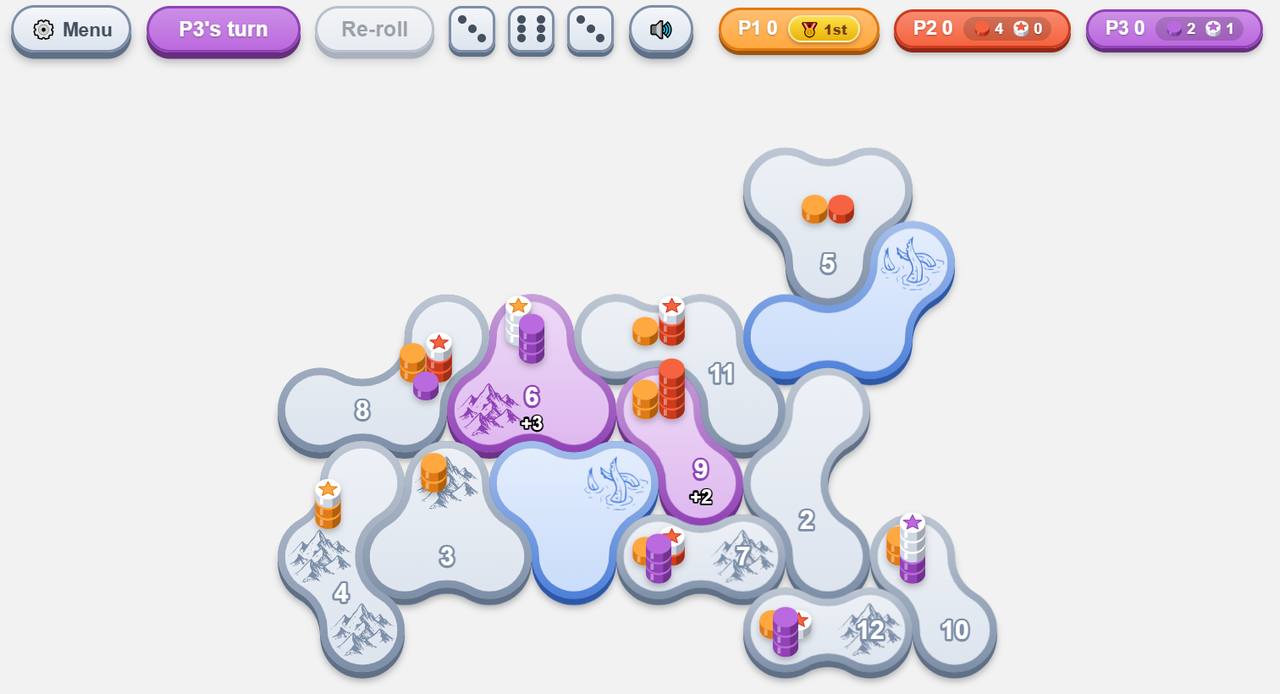
So this isn't anything Fusion related, and I realize it may be controversial, but I decided to see how good AI is at building a game from scratch - in this case, using html, javascript and svg for graphics.
My clone includes:
* a ramdomly generated map,
* a second unit type, which gives you a small amount of agency during the second (scoring) phase,
* a new way of moving units you've already deployed, instead of the tactics cards.
Anyway, I started with Google Gemini, mostly because I know it has generous usage limits. Unfortunately, it wasn't up to the task.
To begin with I just wanted to randomly generate a map using those rounded multi-hex tiles, but despite many attempts, including me trying to break it down into baby steps, Gemini simply couldn't draw those outlined tiles. And then the other huge issue is that it's almost impossible to get it to change something without it also making a whole host of changes you didn't ask for or want. Plus, it would often just break, and I'd have to revert to the previous version. And finally, I was using the preview console to test results immediately, and often that simply wouldn't show.
So then, onto ChatGPT. That was a failure as well, and the usage limits were much stricter, so failing also took a lot longer.
Finally, onto Claude. And wow! Instant success. It immediately understood what I wanted, It didn't make unwanted changes, and I could even give it a long list of changes to make all at once, and it still just worked first time, every time.
The downside is that the usage limits are fairly strict - once the project started getting complex, I found I could only make 1-2 revisions before I'd be timed out for the next 5 hours.
But that's not such a huge problem - as I said, you can make a lot of changes all at once, without any issues.
Also, Gemini doesn't do too badly with modifying a project mostly made by Claude, so I can use it to quickly test a lot of ideas, and then get Claude to implement them itself (I don't trust Gemini enough to use it modify the "proper" version though).
Rules:
- the map has 11 regions, numbered 2-12. this is also how many victory points you get for winning them (you get half that number if you come second in that region). regions separated by exactly one water region are usually considered adjacent. mountains and krakens block adjacency.
- each turn, roll 3 dice. choose two of them and add them together to get the number of the region where you'll be adding counters. the other dice determines how many counters you add to that region.
- you can also move your sphere counter to the new location if you want, and it may transport up to 3 normal counters (without stars) with it from its previous location.
- the first player to place all their counters will win all ties the rest of the game. the last player will lose all ties.
- once all counters have been placed, resolve the regions one at a time, in ascending numerical order.
- the player with the most counters in the region wins the points (see above), but also, immediately gains 2 free counters in every adjacent region where they already had a counter. they can also choose to move any of the counters with stars on that they have in the region, to an adjacent region of their choice where they already had a counter (except they can't cross water).
Anyway, see what you think...
Also, my keyboard is broken, so every single "e" in this post was copied and pasted - hope it was worth the effort!

 Advertisement


 Post Reply